In This Article
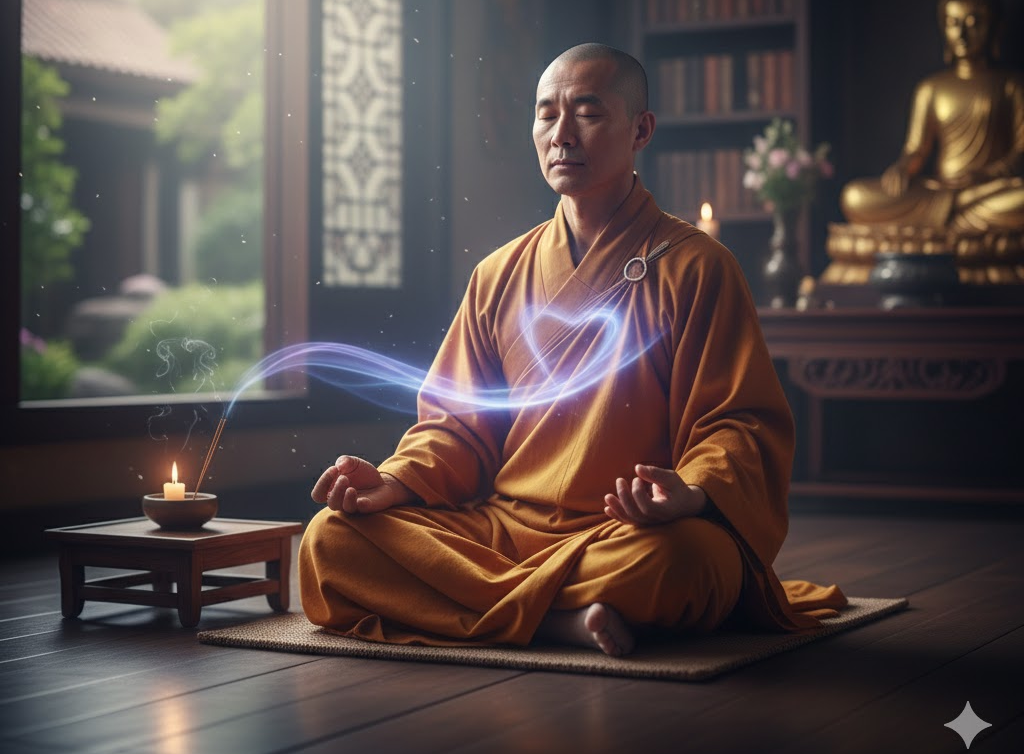
Buddhism has been addressing anxiety for 2,500 years — long before we called it "anxiety." The Buddhist term is "dukkha" (often translated as "suffering" or "unsatisfactoriness"), and the Buddha's first teaching was that dukkha has a cause, and that cause can be addressed.
Modern cognitive psychology is now confirming what Buddhist practitioners have long observed: anxiety is not primarily about external circumstances. It's about how the mind relates to experience. Change the relationship, and anxiety loosens its grip.
Why Buddhist Meditation Works for Anxiety
Secular mindfulness apps teach you to "observe your anxiety without judging it." This is helpful — but Buddhist practice goes further, explaining why you're anxious and offering a systematic path to freedom from it.
Buddhist meditation addresses anxiety through multiple mechanisms:
- Breaking identification with thoughts — anxiety tells you stories ("Something terrible will happen"). Vipassana trains you to see these as mental events, not truths.
- Reducing reactivity — anxiety is fuelled by reacting to discomfort with more discomfort. Equanimity practice breaks this chain.
- Cultivating self-compassion — metta meditation directly counters the self-criticism that amplifies anxiety.
- Understanding impermanence — anxiety assumes the current difficult feeling will last forever. Seeing impermanence directly shows you it won't.
- Calming the nervous system — all Buddhist meditation techniques activate the parasympathetic response, reducing cortisol and adrenaline.
Looking for Professional Support Beyond Self-Help?
Self-help tools and guides are great for daily calm, but combining mindfulness with professional CBT therapy is proven to provide long-term anxiety and stress relief. Online-Therapy.com pairs you with a personal licensed therapist, daily worksheets, audio guides, and journaling tools from $48/week (20% off first month).
Explore Online Therapy (20% Off) →Affiliate link — we earn a commission at no extra cost to you
Featured Mindful.org Official Online Courses & Training
Deepen your daily mindfulness and meditation practice with certified online courses led by world-renowned teachers at Mindful.org:


Official Mindful.org Partner · Self-Paced Online Training
Try Our Free CBT Thought Spotter & Trap Breaker
Identify 8 common cognitive distortions and reframe unhelpful thoughts into balanced perspectives. Runs 100% privately in your browser with zero sign-up.
Open CBT Thought Spotter & Trap Breaker →The Buddhist Model of Anxiety
Buddhism explains anxiety through the Second Noble Truth: suffering arises from craving (tanha). There are three types:
1. Craving for sensory pleasure (kama-tanha)
The anxiety of wanting: "I need this promotion / relationship / outcome to be happy." Future-oriented, grasping, never satisfied.
2. Craving for existence/becoming (bhava-tanha)
The anxiety of identity: "I need to become someone better / more successful / more loved." The feeling of never being enough.
3. Craving for non-existence (vibhava-tanha)
The anxiety of avoidance: "I need this feeling / situation / person to go away." The desperate push to escape discomfort.
Recognising which type of craving drives your anxiety is itself therapeutic — it transforms a vague, overwhelming feeling into something specific and workable.
5 Buddhist Techniques for Anxiety
1. Vipassana Body Scanning for Anxiety Sensations
Time: 15-20 minutes
Instead of trying to stop anxiety, locate it in your body. Where do you feel it? Chest tightness? Stomach churning? Throat constriction? Focus directly on the physical sensation with equanimity — observing without reacting. You'll discover that the sensation is constantly changing, moment to moment. This direct observation of impermanence loosens anxiety's grip more powerfully than any cognitive technique.
2. Metta for the Anxious Self
Time: 10 minutes
When anxiety hits, try this: place a hand on your heart and repeat: "May I be safe. May I be free from fear. May I accept this moment as it is. May I be at ease." The combination of physical touch (heart contact) and verbal compassion activates both the somatosensory and emotional regulation systems.
3. RAIN Practice (Recognise, Allow, Investigate, Non-identification)
Time: 5-10 minutes
Developed by meditation teacher Tara Brach from Buddhist principles:
- Recognise — "Anxiety is here."
- Allow — Let it be present without fighting it. "This belongs."
- Investigate — Where do you feel it in the body? What does it need?
- Non-identification — "I am not my anxiety. This is a passing experience."
4. Tonglen for Anxiety
Time: 10 minutes
From Tibetan tradition: breathe in your anxiety as dark smoke, imagining it dissolving in your heart's spaciousness. Breathe out bright light and relief — first to yourself, then to everyone who suffers from anxiety (millions of people, right now). This practice transforms anxiety from a personal affliction into a connection with shared human experience.
5. Walking Meditation for Acute Anxiety
Time: 10-15 minutes
When anxiety makes sitting unbearable, walk. Buddhist walking meditation gives your body something to do whilst training awareness. The physical movement discharges adrenaline, and the deliberate attention to each step pulls you out of anxious thinking.
Looking for Professional Support Alongside Mindfulness?
Buddhist meditation provides powerful mental equanimity, but combining mindfulness with professional CBT therapy offers faster relief for persistent anxiety and worry. Online-Therapy.com pairs you with a personal licensed therapist, daily CBT worksheets, audio tools, and yoga sessions from $48/week (20% off first month).
Explore Online Therapy (20% Off) →Affiliate link — we earn a commission at no extra cost to you
Daily Anti-Anxiety Practice
- Morning (15 min) — Vipassana body scanning. Start with breath awareness (5 min), then scan the body for anxiety sensations (10 min). Observe without reacting.
- Midday (5 min) — Metta for yourself. "May I be safe. May I be free from fear." Especially useful before anxiety-triggering situations.
- When anxiety strikes (5 min) — RAIN practice. Recognise, Allow, Investigate, Non-identify.
- Evening (15 min) — Walking meditation or yoga nidra. Release the day's accumulated tension.
Start with just the morning session. Add others as the practice becomes habitual. Even 15 minutes of daily vipassana produces measurable anxiety reduction within 2-4 weeks.
Best Apps & Programs for Anxiety Mindfulness
| Program / App | Anxiety Content | Price | |
|---|---|---|---|
| Online-Therapy.com | Licensed therapist + CBT worksheets & mindfulness | From $48/wk (20% off) | Get 20% Off → |
| Insight Timer | Free vipassana + metta for anxiety | Free | Read Review → |
| Waking Up | Deep vipassana + philosophical context | $99.99/yr | Read Review → |
| Headspace | Secular mindfulness with Buddhist roots | $69.99/yr | Read Review → |
When to Seek Professional Help
Buddhist meditation is powerful for anxiety, but it has limits. Seek professional help if:
- Anxiety prevents you from working, socialising, or daily activities
- You experience frequent panic attacks
- Meditation makes your anxiety worse (this can happen with certain types)
- You're using substances to manage anxiety
- Anxiety persists after 6-8 weeks of consistent practice
Meditation and therapy work beautifully together. Many CBT therapists now incorporate mindfulness (from vipassana) into treatment. BetterHelp and Talkspace make therapy accessible from home.
Professional Support: BetterHelp
Licensed therapists who can integrate mindfulness into your treatment plan. Match within 24 hours.
Get Started with BetterHelp →Affiliate link — we earn a commission at no extra cost to you
Take Our Free Anxiety & Wellness Self-Assessment
Check your stress levels and get matched to the right relaxation exercises for your mood.
Start Free Assessment →FAQs
Which Buddhist practice is best for anxiety?
Vipassana body scanning for general anxiety. Metta for anxiety driven by self-criticism. Walking meditation for acute/physical anxiety. Tonglen for anxiety that feels isolating. Start with vipassana and add others based on what you need.
Can meditation make anxiety worse?
Occasionally, particularly with extended silent meditation. If this happens, switch to shorter sessions, guided practice, movement meditation (walking or yoga), or metta. If anxiety consistently worsens, consult a therapist.
How does Buddhist meditation compare to CBT for anxiety?
They complement each other. CBT changes the content of anxious thoughts ("Is this thought realistic?"). Buddhist meditation changes your relationship with thoughts ("I don't need to engage with every thought"). MBCT (Mindfulness-Based Cognitive Therapy) explicitly combines both approaches.
Related Articles

Sources & References
- [1] Frontiers in Human Neuroscience / PubMed — Neurobiology of Buddhist Meditation and Focused Attention Practices
- [2] Springer / Mindfulness Journal — Theravada Mindfulness Practices (Anapanasati & Vipassana) in Modern Psychological Interventions
- [3] NCCIH (National Institutes of Health) — Meditation: In-Depth Overview
For general information only, not a substitute for professional medical care. In a crisis or severe symptom onset, consult a qualified healthcare provider immediately.