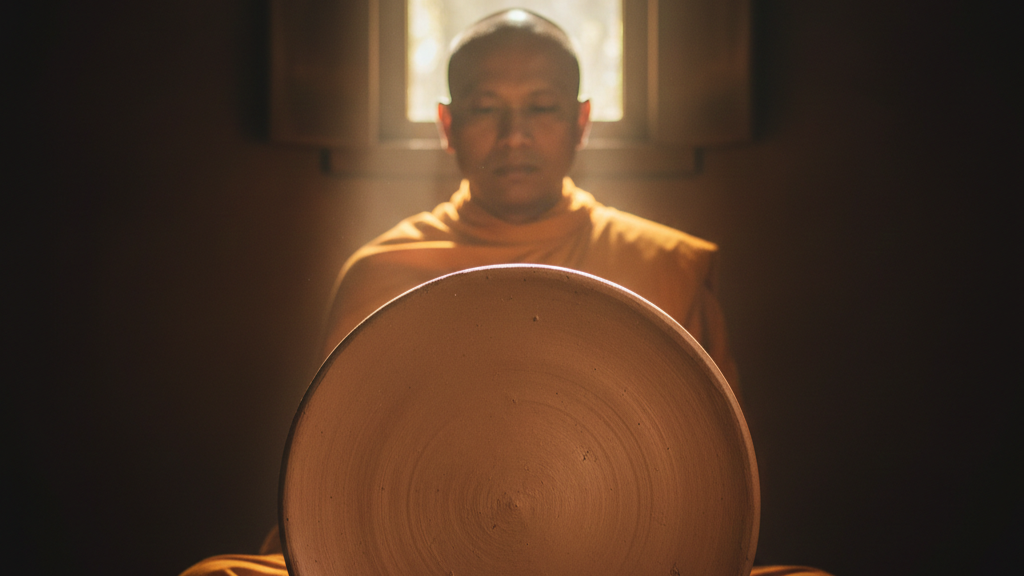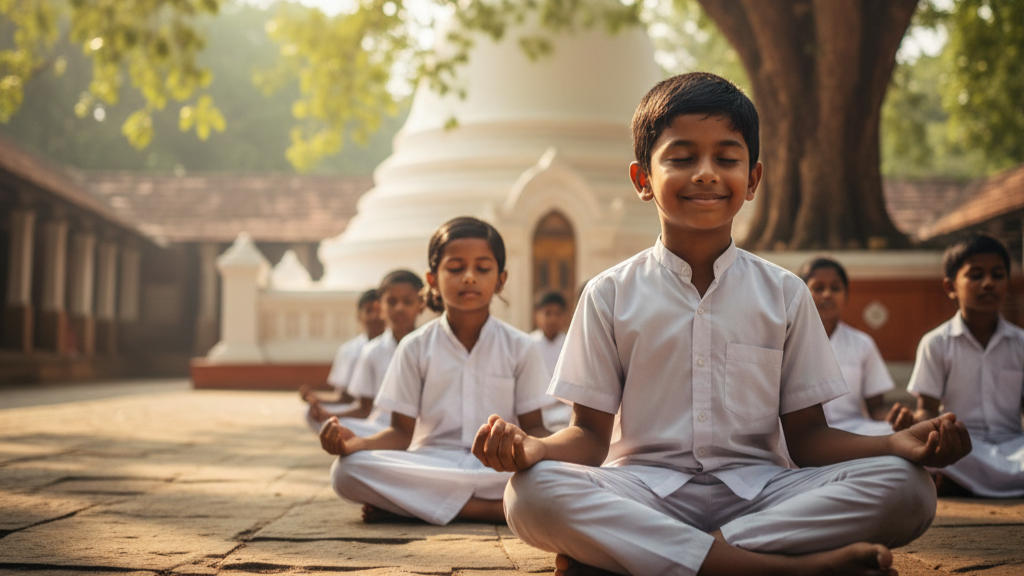
While Western parents debate whether meditation apps are appropriate for children, Sri Lankan children have been learning meditation in Dhamma schools since 1869. Every Buddhist temple in Sri Lanka runs a Sunday school (Daham Pasala) where children aged 5-16 learn Buddhist philosophy, chanting, and meditation as naturally as they learn reading and mathematics.
How Sri Lankan Children Learn
Ages 5-7: Breathing and Kindness
The youngest children learn two practices. First, 'Buddha breath' — sit cross-legged, hands on knees, close eyes, breathe in 'Bud-' breathe out '-dha.' The word gives the breath a rhythm and the child a focus point. Sessions last just 2-3 minutes. Second, metta phrases — 'may my mother be happy, may my father be happy, may my teacher be happy, may all beings be happy.' Children repeat these phrases with palms together, learning to generate kindness systematically.
Ages 8-12: Breath Counting and Body Awareness
Older children learn anapanasati basics — counting breaths 1-10 for 5-10 minutes. They also learn mindfulness of daily activities: eating mindfully (knowing each bite), walking mindfully (feeling each step), and listening mindfully (paying full attention when someone speaks). Teachers use stories from the Jataka tales (the Buddha's past lives) to illustrate mindfulness principles.
Ages 13-16: Formal Meditation
Teenagers learn formal sitting meditation: 15-20 minute sessions of anapanasati and metta. They study the four foundations of mindfulness (satipatthana) in simple terms. Many participate in one-day Sil programmes on Poya Days — observing the Eight Precepts and meditating with adults.
Techniques Any Child Can Use
1. Counting Breaths Game (Ages 5+)
Child sits comfortably. Breathes normally. Counts each exhale on fingers: 1, 2, 3... up to 10. Then starts again. If they lose count, they smile and restart. Make it playful — 'let's see if we can get to 10 three times.' Duration: 2-3 minutes.
2. Kindness Wishes (Ages 4+)
Before bed, child thinks of 5 people and sends each a wish: 'I hope [name] is happy tonight.' Start with family, expand to friends, then teacher, then someone they find difficult. This is metta practice simplified for children — and it works remarkably well for calming bedtime anxiety.
3. Listening Game (Ages 5+)
Sit quietly. Close eyes. Count how many different sounds you can hear in 1 minute. Birds, traffic, wind, breathing, fridge humming. This develops present-moment awareness without the abstract instruction of 'be mindful' that confuses children.
4. Eating Meditation (Ages 6+)
Take one raisin (or any small food). Look at it closely for 30 seconds. Smell it. Place it on the tongue without chewing. Notice the taste. Slowly chew. Notice the texture changing. Swallow mindfully. Sri Lankan Dhamma school teachers use this with tropical fruits — mango, rambutan, or banana — making it a sensory adventure.
5. Walking Count (Ages 7+)
Walk slowly across the room. Count each step silently. Stop at 20. Turn around. Walk back counting from 1 again. The physical movement makes this more accessible than sitting meditation for energetic children.
Why It Works in Sri Lanka
Three factors make meditation natural for Sri Lankan children: community (everyone does it — parents, grandparents, teachers, monks), regularity (weekly Dhamma school, monthly Poya Days, daily home practice), and normalisation (meditation is as ordinary as brushing teeth, not a 'special' or 'weird' activity). Western parents can replicate these conditions by practising alongside their children, making it a regular family activity, and treating it as normal rather than exceptional.
Related: Meditation for Beginners and What Is Mindfulness?.